Olive Garden loses money on that pasta pass. That's the design.
A $100 pass for 13 weeks of unlimited pasta looks like a giveaway. It's a loyalty loop: three parts that build a habit, plus two that get people through the door. The same five run Costco, your gym, and every app on your phone. Here's the architecture, and why it's the right bet in 2026.
On July 16, Olive Garden put 10,000 pasta passes on sale. A hundred dollars each, thirteen weeks, unlimited pasta.
Someone who eats there twice a week clears their $100 in a fortnight, then eats free for eleven weeks. Olive Garden has run those numbers more carefully than you or I ever will. They sold the passes anyway — on purpose, at a planned loss on their keenest customers.
So here's the question worth understanding: why would a 950-restaurant chain design an offer to lose money — and what makes it work?
Because the pass was never the product. It's a machine that turns a one-off discount into a lasting habit — a subscription loop. And it has a shape worth learning, because it runs Costco, your gym, your airline's status tier, and nearly every app on your phone.
The shape is this: three parts build the habit, and two more get people through the door in the first place. Miss the door and nobody enters. Miss the loop and they leave the moment the offer ends. You need both.
Here's the architecture, part by part — and why building one is the right move right now, not just a clever trick.
Is this just a fancy discount?
No — and mistaking one for the other is the most expensive error in loyalty marketing. A discount changes one purchase. A loop changes a habit. The pass doesn't sell cheap pasta; it manufactures a reason to come back until the visit itself becomes the default. The discount is the bait. The habit is the catch.
Watch what the pass does to one customer, visit by visit — because this is where the loyalty gets built, and it's invisible if you only look at the sale.
Visits one to six, they're doing math. "I've paid $100, I've had six meals, I'm about even." A bargain-hunter, enjoying the win. Nothing loyal yet — they'd drop the place for a better deal tomorrow.
Visit seven, they break even. Every meal from here is free. In a normal promotion, this is the finish line.
Visits eight, nine, ten — this is the part Olive Garden actually paid for. The customer has stopped calculating, because they're ahead and there's nothing left to count. Something quieter takes over: they're just going to Olive Garden on a Tuesday. It's become the answer to "where should we eat?" — a question that, thirteen weeks ago, had no automatic answer.
That's the mechanism. The three visits past break-even didn't give away three free meals; they overwrote a habit. When the pass expires, the math is forgotten and the default remains. On earlier editions, this showed up cleanly: break-even near seven visits, average passholder back around ten. Those extra three are the whole design.
The difference between a discount and a loop is a shape:
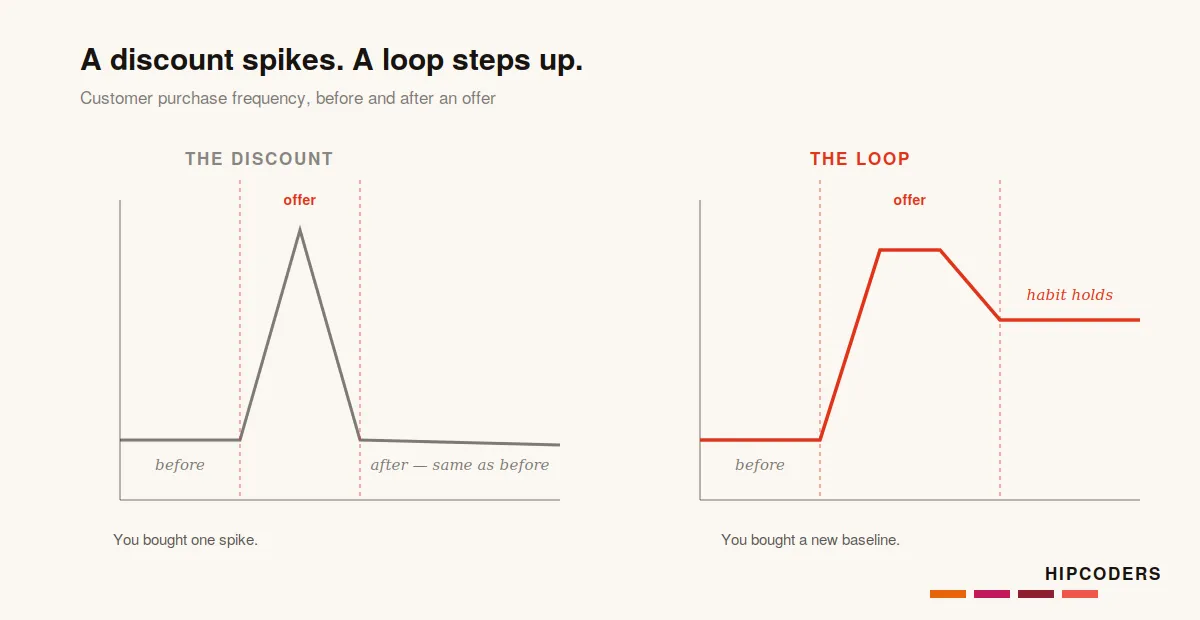
A discount buys a sale. A loop buys the next sale, and the one after that.
If your recurring offer doesn't lift the baseline — if the customer does exactly what they did before once the deal ends — you ran a discount and called it loyalty.
Do this today
Look at your last promotion. Did the people who used it buy differently afterwards, or snap back to their old pattern? If they snapped back, you bought a spike. That's fine — as long as you know that's what you paid for.
What are the parts of a subscription loop?
Five, in two groups. Three build the habit — the hook that gets someone in, the tipping point where they cross into a routine, and the reward that keeps them there. Two more open the door — a cap and an expiry that push a hesitant person to start. The three are the engine; the two are the ignition. Miss the door and nobody enters. Miss the loop and nobody stays.
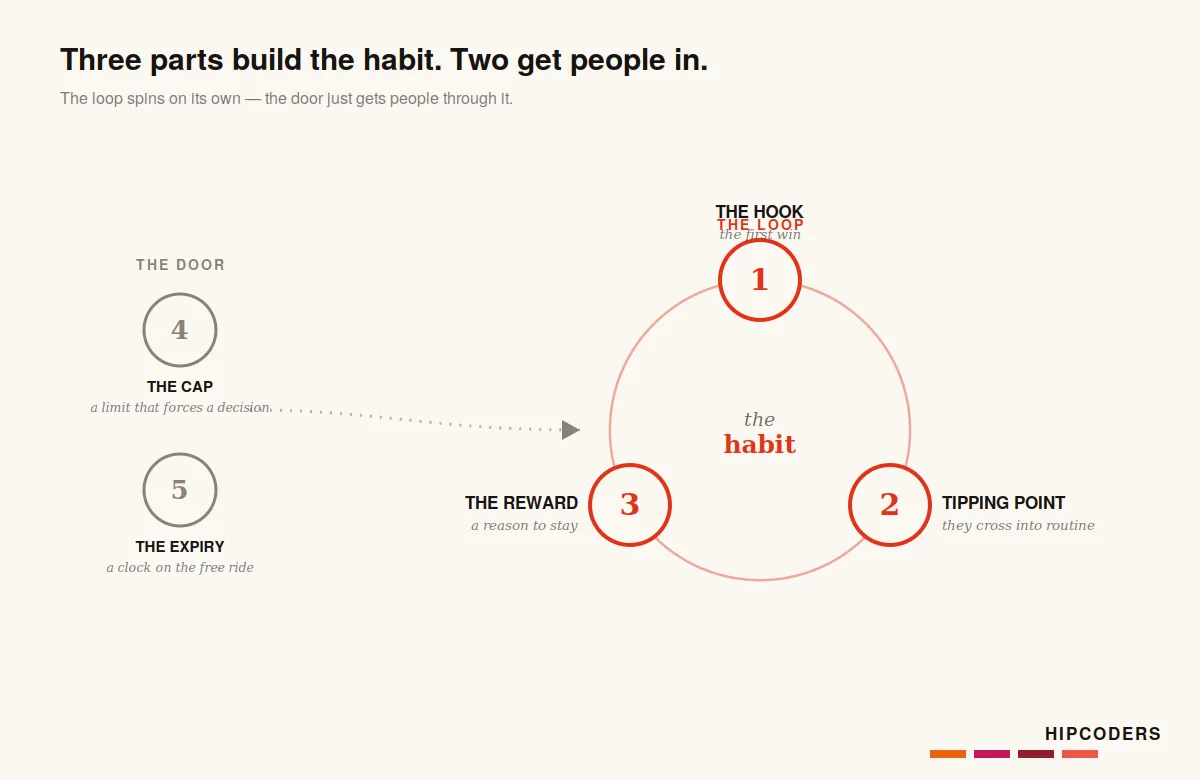
The rest of this piece walks each part, built on the pass and stress-tested somewhere it isn't a restaurant — because a framework that only fits one business is just a case study wearing a suit.
Do this today
Write your own offer against those five. Any part you can't name — no cap, no expiry, no tipping point — is the one about to leak.
The loop — the three parts that build the habit
How do you price the hook so it's irresistible but not ruinous?
Price it below what your most frequent customer already spends over the window — and nobody else. It has to feel like a steal to the heavy user, because they form the habit and bring the friends. It loses money on that person in isolation. That loss is your advertising budget, and it's cheaper than the ad you'd have run instead.
The pass costs less than a fortnight of twice-a-week visits — to someone who already loves the place, free money. That's the point. The hook is priced for the frequent customer, not the average one, because that person is the engine: they form the habit fastest, post about it, and drag in friends who pay full freight.
Here's the reframe. Olive Garden could have spent that margin on ads — attention rented from strangers who feel nothing. Instead they spent it on their keenest customers, who convert it into visits, word of mouth, and thirteen weeks of showing up. A loss leader aimed at people who already like you is a loyalty budget with better returns than an ad.
Do this today
Work out what your top 10% of customers spend in a month. Price a hook a notch below that. It should feel slightly reckless — if it feels safe, you've priced it for the average user, and the heavy users who'd have formed the habit will never bite.
Where is the tipping point, and how do you push customers past it?
It's the use where the customer stops doing math and starts running on habit. Below it, they're a bargain-hunter who vanishes when the deal ends. Above it, the behaviour has rewired. Your job is to design an offer generous enough to drag people past that line before the novelty fades.
Every recurring offer has a break-even — but that's not the number that matters. The one that matters sits a few uses beyond it, where the habit sets:
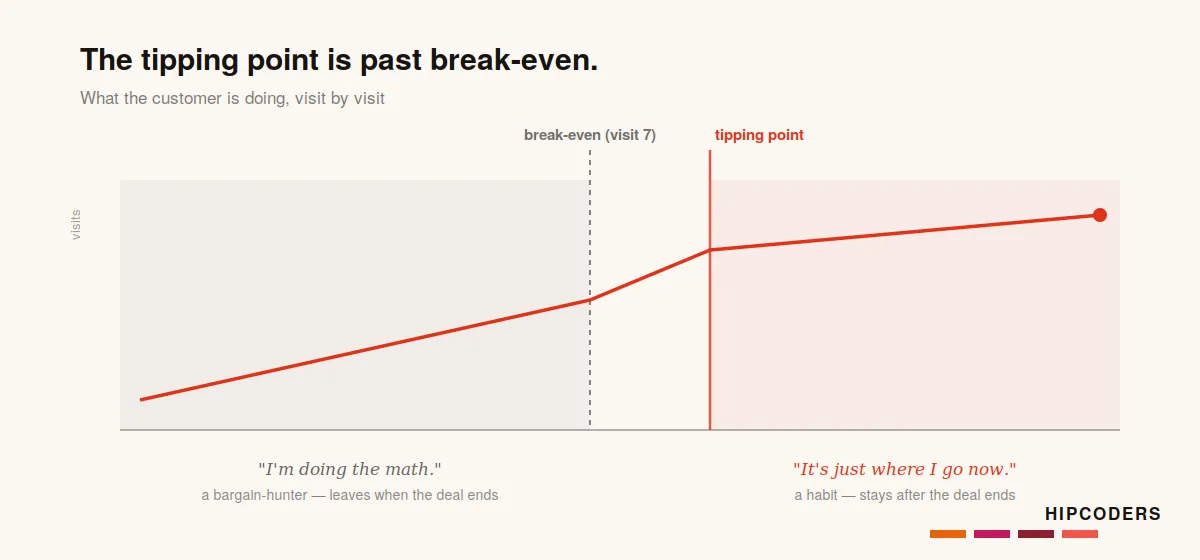
The pass is engineered for exactly this: thirteen weeks, long enough for a habit to form, finite enough to keep urgency. This year's edition stretched five weeks longer than earlier ones — more room to drag people past the line.
The number is different for every business, and finding yours is the whole game. A gym's tipping point is brutal and instructive: the entire model sells access most members won't use, and the "habit" the good ones form is identity — the visit where they start calling themselves "someone who goes to the gym." Cross it and they renew for years on twelve visits a month. Fall short and they cancel in March. Same membership, opposite outcome, decided by whether the offer got them past the line.
Do this today
In your repeat customers, find the use-number where retention suddenly holds — where people who reach use N almost always come back. That N is your tipping point. Your offer has to be generous enough to get people there.
How do you reward existing customers without training everyone to wait?
Give the people already inside your world first access — your list, your past customers, your members. Being early is the reward, and it's reserved for people who already raised their hand. That flows the generosity toward loyalty instead of toward bargain-hunters, and it turns your list into the thing people join to get in.
Pass holders and the email club get early access ahead of the public. The airline version is the whole business model: the reward for flying enough isn't a discount, it's the earlier boarding group, the upgrade, the lounge — status worthless to outsiders, precious to insiders, and impossible to buy without first being loyal.
That aiming matters. An offer open to everyone teaches strangers to wait for your next discount; one that flows first to your list teaches people to get on your list. One trains bargain-hunting, the other builds the owned audience every future promotion gets cheaper to run against — and reserving the best version for insiders turns a price war into a membership perk. Perks build loyalty where discounts erode it.
Do this today
Give your existing customers or list a genuine head start on your next offer — even 24 hours — then say so publicly. The head start is the reward; the announcement is what makes people join before the next one.
Those three — hook, tipping point, reward — are the loop. Together they spin on their own: once someone's protecting a streak or a status they've built, you barely have to push. But a loop is worthless if nobody enters it. That's what the last two parts are for.
The door — the two parts that get people in
Why does capping supply make the offer stronger, not weaker?
Because scarcity turns an offer into an event, and events earn attention discounts can't buy. Olive Garden could sell unlimited passes. It sells 10,000, they vanish in minutes, and the sellout does two jobs at once — neither of which an unlimited offer does.
This is where most businesses flinch: if it sells out in milliseconds, aren't you leaving money on the table? No — because the sellout is the marketing, and it runs on two gears.
First gear: it forces a decision. An unlimited offer is a standing option — available any time, so you feel nothing and act later or never. A capped offer has a door that closes. That turns a mild "I might" into a sharp "I have to decide now." It's why people set alarms for a pasta pass and not a coupon. The cap didn't make the pasta better; it made missing out possible, and missing out is what creates urgency.
Second gear: it sells to the people who lose. The 10,000 who got a pass matter less than the far bigger crowd who tried and failed. For three months, those people watch the Never-Ending Pasta Bowl run at full price ($14.99, open to all), feeling the small sting of the thing they missed — a craving the cap manufactured for free. A chunk of them resolve it the only way left: they buy the full-price bowl.
So the cap sells twice: passes to 10,000, and full-price meals to everyone who was made to want what they couldn't have.
Do this today
If your recurring offer has no limit, put one on the next round — a number, a deadline, or both. Watch the conversation change. Scarcity you manufacture is the cheapest attention you'll ever buy.
How do you stop a repeated promotion from becoming the price?
End it hard, and don't run it so often that customers can wait it out. A promotion you run every month isn't a promotion — it's a discount you haven't admitted to, and it teaches customers your full price is a fiction. The expiry is what keeps the real price real.
This failure kills most loyalty programs slowly, so nobody notices until it's done. Run the promotion once: an event, and it works. Run it every quarter on a predictable rhythm, and something breaks — customers stop seeing your regular price as the price. They see two: the fake one, and the one that comes around if they wait. Buying at full price now feels like a mistake, so your most engaged customers — the ones paying closest attention — are exactly the ones who learn to wait. You've trained your most valuable segment onto your lowest margin, and you can't stop: if you don't run it, they simply don't buy.
The pass avoids this three ways: rare (years between outings), scarce (capped), finite (thirteen weeks, then gone). All three protect the same thing — the integrity of the normal price.
Do this today
Count how many times you ran your signature offer last year. More than a couple, and your customers have already learned to wait. The fix isn't a better offer — it's running the good one less often, and holding your price in between.
What does this look like in a phone app?
The same shape — three loop parts, two door parts — wired to mechanics you already know if you've ever tried to learn a language on your phone. That app with the streak isn't running a different playbook to Olive Garden. Same loop, same door, and because it's software you can see every part working on the screen.
You know the app I mean. Here's its loop, part by part — and notice it never once looks like a "discount."
The hook isn't a price — it's the first win. You finish a lesson in ninety seconds, on the couch, and the app throws confetti. It cost you nothing and you got a small hit of progress. That's the hook: not cheap, but frictionless and immediately rewarding, priced (in effort) at almost zero for the person who already meant to learn Spanish someday.
The tipping point is the streak. This is the genius part, and it's worth seeing clearly. The app isn't trying to teach you Spanish on day one — it's trying to get you to day three, because once you've got a three-day streak, a new thing is at stake: not losing it. The habit isn't "I want to learn Spanish." It's "I don't want to break my streak." That's a different, stronger motivation, and it's manufactured entirely by the counter in the corner. The break-even was never linguistic. It was the moment protecting the streak became its own reason to open the app.
The reward is the notification — and it's aimed at the streak, not at you. "Don't lose your 6-day streak!" lands on your lock screen at the hour you usually practise. It's not nagging you to learn; it's reminding you what you'll lose. Same mechanism as Olive Garden's early-access email — a nudge reserved for people already inside — but pointed at the thing you're now afraid to break.
That's the loop — hook, tipping point, reward — and it runs whether or not you ever pay. The door is the paywall. "Your free trial ends in 2 days" is the expiry, a clock forcing a decision; the periodic "50% off, this weekend only" is the cap, a discount that isn't always there so upgrading becomes a now choice. The door converts the habit into revenue — but notice the habit came first.
The reason this app is worth studying isn't the owl. It's that software lets you see the loop run — the company knows exactly who hit their third-day streak and who churned on day two, cohort by cohort. That visibility is why the best app companies are ruthless about the tipping point: they can watch, to the user, where the habit forms and where it fails. (Building that same view for a business that can't see it natively — a café, a clinic, a car wash — is a Signal desk job.)
Do this today
Write down your product's version of the streak — the single moment a user starts protecting something rather than just consuming. Then find how many new users reach it before they go cold. If most never get there, your problem was never the price. Your tipping point sits on the far side of your trial.
Why is this the right bet in 2026?
Because acquisition is getting more expensive every quarter, and a loop is the cheapest hedge against it. When it costs more to find a new customer than it did last year — and it does, sharply — the business that keeps its customers longer wins by default. A loop doesn't just retain. It spreads one acquisition cost across a lifetime of purchases, which is the only durable answer to rising ad prices.
This isn't a timeless tactic that happens to be in the news. It's the correct response to a specific, worsening problem, and the numbers are stark.
Paid attention is inflating fast. Meta's Q1 CPM hit an all-time high of $10.88 in 2025, up 19.2% year-over-year; Google CPCs rose 12.88%. And it's less effective, not just costlier — overall ROAS fell 10.03% in 2025. You're paying more and getting less, from platforms that keep more of the value each year.
Meanwhile the ground under targeting has shifted. Roughly 90% of marketers have shifted toward first-party and zero-party data strategies, and it pays off directly: companies with mature first-party data ecosystems reported a 34% lower average CAC compared to peers still relying on third-party cookie-based targeting. A loop is a first-party audience machine — every member is a customer you can reach without paying a platform for the privilege.
And the retention math has always been lopsided; rising acquisition costs just make it decisive. It costs 5 to 7 times more to acquire a new customer than to retain one, and a 5% increase in retention lifts profit by 25% to 95%. Here's the number that ties the whole argument together: subscription-model merchants who amortized their acquisition cost across an 18-month average customer lifetime reported an effective monthly CAC of just $17.67 — economics 3.2 times more efficient than one-time buyers.
That's the strategic case in one line. A loop doesn't just keep customers — it makes acquisition cheaper, by spreading the cost of winning someone once across everything they buy afterward. When ads get more expensive every quarter, that's not a nice-to-have. It's the hedge.
Do this today
Work out your own blended acquisition cost, then divide it by how long your average customer actually stays. If that second number is "one purchase," you're paying full price for every customer, forever — and a loop is how you stop.
So how do you know it worked?
Not by how many passes you sold — that's the vanity number. Track the people who used the offer and watch their purchase rate for the three months after it ends. A loop leaves a permanent lift. A discount leaves a crater — a spike, then back to baseline or below, because you also taught everyone to wait for the next deal.
Ten thousand passes gone in minutes tells you the hook was priced right. It tells you nothing about whether you built a habit or found ten thousand bargain-hunters. The honest test is the after — and most businesses never run it.
Do this today
Pull the people who used your last promotion and compare their purchase rate in the two months after it ended against the two before. That single number tells you whether you've been building loops or buying spikes. (Building the view that shows it cleanly, cohort by cohort, is a Signal desk job.)
Olive Garden didn't sell you cheap pasta. It sold a habit, wrapped in scarcity, aimed at the people most likely to keep it — and priced it to look like a giveaway, because the loss is cheaper than the advertising it replaces.
Build the loop — a hook, a tipping point, a reward — so people stay. Open the door — a cap, an expiry — so they start. Measure the frequency that holds after the offer ends, and you've built something that compounds, whether you're selling pasta, memberships, or an app.
In a year when finding a new customer costs more every quarter, keeping the ones you have is the whole game. That's a Growth problem, and it's the kind I build systems to solve. I do this for a living →
— Hipcoders
Sources: Olive Garden / Darden Restaurants press release and reporting, July 2026 (10,000 passes at $100; 13-week window; early access for pass holders and EClub members). Axios, July 2026: earlier eight-week editions broke even for diners near seven visits, average passholder returning about ten times — figures from the pre-2026 format, so directional for the 13-week edition. CAC and ad-cost figures: Varos / Mobiloud 2026 benchmark reporting (Meta CPM $10.88, +19.2% YoY; Google CPC +12.88% YoY; ROAS −10.03%, all 2025); Profitwell / Forrester 2026 reporting (first-party-data firms ~34% lower CAC; ~90% of marketers shifting to first-party strategies); Shopify Global Commerce Report 2026 (subscription merchants' effective monthly CAC $17.67, ~3.2× more efficient); retention/profit figures per widely-cited Bain/HBR-lineage benchmarks as compiled in 2026 CAC roundups. Costco, gym, airline, and meditation-app examples are illustrative.