Nobody starts at the top of your funnel. Every page is page one.
You don't choose which page a stranger lands on. They do. So that one page has to do the whole funnel by itself, in seconds.

How do people arrive at your website?
Almost never at the front door. They land on one inside page, from a search or a link, having seen nothing else you have ever made. So that single page has to do every job the funnel spreads across five stages. All of it. On its own. In seconds.
Where they actually land
Someone types a question. Google hands them one page. It might be page four of your site, or an article you wrote two years ago and forgot.
They read it. They decide. Most of them never see a second page of yours.
That is the whole event. One page, one stranger, no context at all. There is no page two to lean on, because for most visitors there is no page two.
Six questions sort this out, and each one answers the objection the last one raises.
1. What is a marketing funnel actually for?
It lists five things every buyer needs before they will pay you. That list is correct. It was built in a world where the seller decided what a buyer saw first, second and third. The control is what has gone. The list outlived it.
It worked because someone else picked the order
Plenty of people will tell you the funnel is nonsense. It isn't. It worked extremely well for about a hundred years.
Here it is, stripped back. Wide at the top, narrow at the bottom, five stages in order. Each stage asks a fair question:
- Find you. Can people find you at all?
- Understand you. Do they get what you do, and who you do it for?
- Trust you. Do they believe you can actually do it?
- Act easily. Is the next step obvious, and is it simple?
- Come back. Will they return, or tell someone?
Nothing is wrong with any of those. A business that can't answer all five doesn't get paid.
The problem is the word order. Think about how buying used to happen. A rep knocked and took you through the whole thing in one conversation. Or you saw an ad on telly, then went to the showroom, then talked to the man on the floor.
In both of those, the seller decided the running order. First they made you aware. Then they explained. Then they earned your trust. Then they asked for the sale. You met the five things one at a time because that was the order you were handed.
The funnel was never a theory about how people think. It was a description of a sequence the seller owned.
Then search happened.
Nobody hands a stranger anything in order now. They choose their own way in, based on their question, not your plan.
So if the order has gone, what replaces it?
2. So should I throw out the funnel and just answer questions?
No. Keep the five things. Throw out the five stages. The five things still have to happen before someone pays you. They just can't be spread across five visits any more. They all have to happen on whichever single page that person lands on.
Which pages? All of them
The old model: five things, five stages, spread over days. A blog post makes you aware. A guide explains. A case study builds trust. A sales page closes. An email brings you back.
What actually happens: someone lands on the blog post, and that is the only page of yours they will ever see.
So here is the part that catches people out. Your blog posts are sales pages now. You didn't decide that. Google did, by sending a stranger straight to one.
That means there is no such thing as a page that only does one job. Every page a stranger can land on from a search has to do all five. The article, the service page, the pricing page, the one you wrote three years ago and forgot about.
So what do all five look like when they land on one page?
3. What do all five look like on one page?
Answer the question that brought them. Say who you are and where you work. Show one piece of real proof. Say exactly what happens next. Give them a reason to come back if they are not ready today. That is the whole funnel, and it fits on one phone screen.
Watch one visitor, one page
On Thursday, Priya is told her job is going. She is handed papers and asked to sign them by Monday. She is frightened she will sign away something she cannot get back.
That night she types: do I have to sign a redundancy agreement straight away.
Google gives her ten results. She clicks a law firm. The page is headed "Commercial and employment law excellence since 1994." Nothing on it is about signing on Monday.
Back button.
She clicks the next one. The heading says "Asked to sign a redundancy agreement? You almost never have to sign on the spot. Here's what to check first." It answers her in two lines. Further down it says who wrote it, that they act for employees not employers, and that they've handled 60 of these in the last year. Then: send the letter over, we'll tell you within a day whether it needs a lawyer at all, no charge.
Same papers. Same Thursday night. One of them gets the call.
The second page did all five things at once. It answered her question, said who and where, showed proof, said what happens next, and gave her something she could do while she was still deciding.
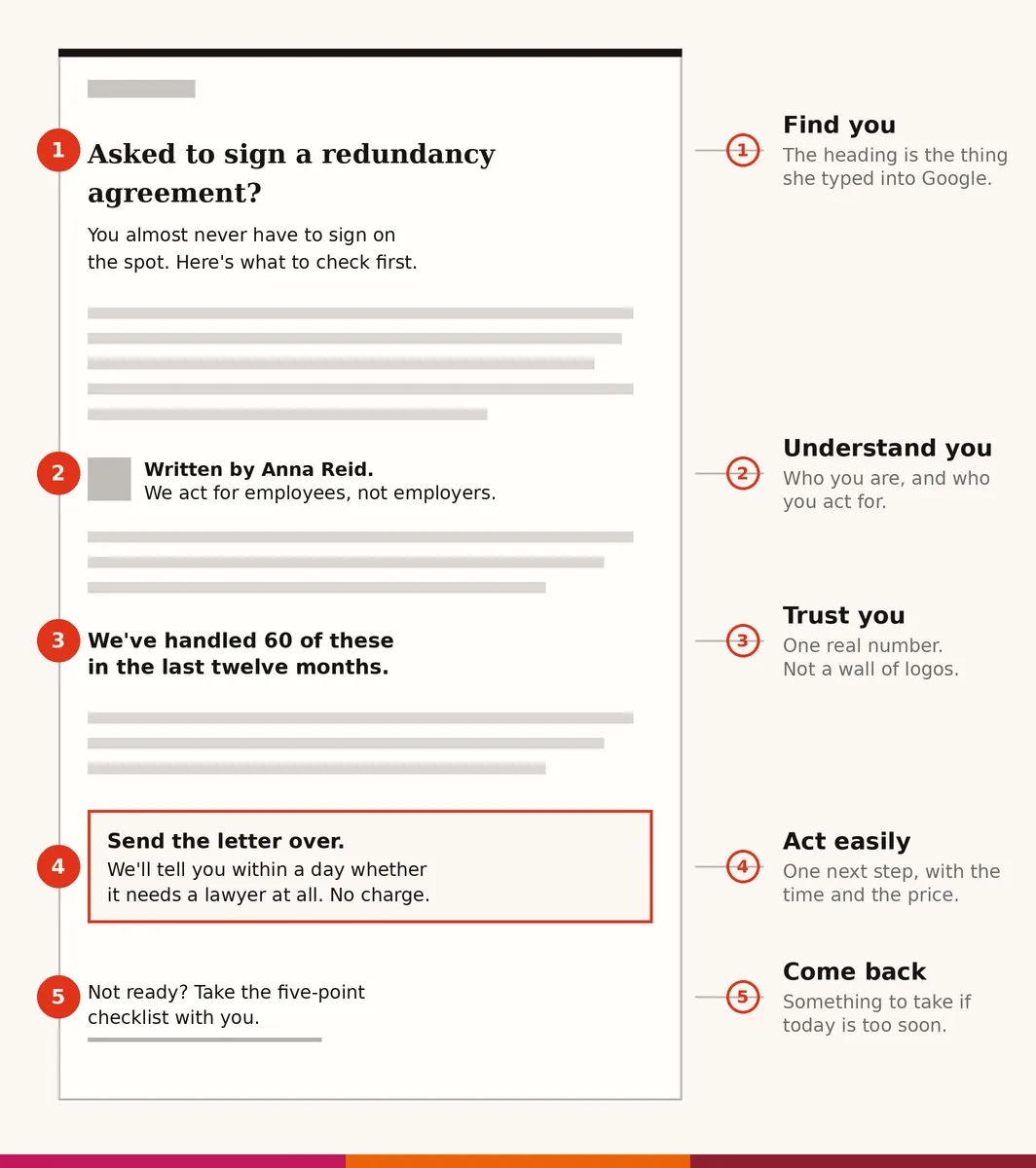
Here is the full set, and what it costs you when one is missing.
| The five, in order | What it looks like on your page | What breaks without it |
|---|---|---|
| 1. Find you | The heading is the thing they typed, answered in the first two lines | They're gone inside ten seconds. Nothing else you wrote gets read |
| 2. Understand you | Plain words saying what you do and who for, plus a name and a place | A stranger can't tell if you're near them, or if you handle their kind of job |
| 3. Trust you | One dated photo, one real number, one named client. Not a wall of logos | They believe you're capable. They don't believe you've done this before |
| 4. Act easily | One clear next step, with the price or the word free, and a timeframe | They mean to get in touch later. Later doesn't arrive |
| 5. Come back | Something useful to take away, or a reason to return when they're ready | You lose everyone who isn't ready today, which is most of them |
Read that table as Priya. Every row is a thing she needed at 10pm on a Thursday.
Which raises the obvious worry.
4. Doesn't that turn every page into the same page?
It feels like it will, and it doesn't. The five things stay the same on every page. The answers to them change completely, because a different question at the top means a different person reading, with a different worry and different proof that would settle it.
Same five things, different answers
Picture a shop that sells kitchen mixers and drinking glasses.
Both product pages have to do all five things. Not one of the five is answered the same way.
The mixer page answers a person who wants to know if it will handle bread dough without walking across the bench. Its proof is a video of it kneading a heavy dough. What happens next is a two-year warranty and next-day delivery, because they want it for the weekend.
The glasses page answers a restaurant owner ordering 200 of them. Her worry is chipping and replacement cost. Her proof is a photo of the same glasses on a table after a year of service. What happens next is a trade account and a lead time, because she needs them before a Friday booking.
Same five things. Same shop. Nothing shared between the two pages except the shape.
So you can't build the five once and paste them onto every page. It's the obvious shortcut, and it falls apart the moment the question at the top changes.
It works the same in any trade. An electrician's page on how much does it cost to rewire a house proves itself with a real invoice range. The same electrician's page for power's out and it's Sunday night proves itself with the hours and the callout fee. A supplier's page on who sells compostable takeaway containers in Sydney proves itself with a minimum order and a lead time.
The five things are the questions your buyer is asking. Every page has to answer all five, and no two pages answer them the same way.
So which of your pages are answering all five, and which are answering one?
5. Which of my pages fail this, and how would I know?
Two free reports tell you nearly everything. Google Search Console shows what people typed to reach you. Google Analytics shows which page they landed on. Read them side by side and the pages doing the most work with the least equipment stand out fast.
Two reports, twenty minutes
Search Console → Performance → Queries. What people actually typed. Not what you hoped they typed.
Google Analytics → Reports → Engagement → Landing page. Where they arrived first.
Put them together and one pattern turns up almost every time. Several different questions, all landing on one page that half answers them. That page is being asked to be five doors at once, and failing at all of them.
You'll find the reverse too: pages you were proud of that nobody lands on, because they answer a question nobody types.
There is one honest question left, and it decides whether any of this is your problem at all.
6. Where does the funnel still work perfectly well?
After the money. The funnel needs you to control the running order, and once someone has paid you, you do again. You choose what gets sent, and when, and what comes next. So the stages come back the moment the sale is done.
The order comes back, and so does the funnel
This is the same rule as section 1, running the other way.
Before someone buys, you have no say in what they see first. They pick. That is why the stages don't help you there.
After they buy, you have their email, their number and their permission. You decide what happens on day one, day thirty and day ninety. The order is yours again. So a sequence works, because now there genuinely is one.
That is the part of the funnel I would leave completely alone. Loyalty schemes. Customer groups. Emails that sell the next thing. Software that spots who is about to leave.
Those are real problems, and some businesses need them badly. They are also not what I get hired for. Saying so is cheaper for both of us than teaching you something I can't help you build.
What I will say is what I keep seeing. Very few people have a problem keeping customers. Most have a problem getting a stranger past the first page.
What should I do this week?
One sitting, about an hour, nothing to buy. Five steps in order. Each one hands you a piece of evidence rather than an opinion, and by the end you are holding proof of which page is losing people and exactly which of the five things it is missing.
The hour that tells you where you stand
1. Find out whether the home page even matters. Open Google Analytics. Reports → Engagement → Landing page. Set it to the last three months. Work out the share of visits that started on any page other than your home page.
Over half means most of your visitors never see your home page, and every assumption you had about what they see first is wrong. Almost none means hardly anyone finds you through search at all. That's a Get found desk problem, and no amount of page-building will shift it.
2. Get the real questions, in their words. Open your sent emails. Find the last ten replies you wrote to someone who was thinking of hiring you. Write down what each of them actually asked, in their sentence, not your summary. Not "pricing enquiry." The real thing: "Do I have to sign this by Monday?"
3. Put a web address next to each one. Beside each question, write the address of the page on your site that answers it. Not mentions it. Answers it.
The blank lines are the finding. Each blank is a person who typed that, landed somewhere that didn't answer it, and left.
4. Score one page as a stranger would. Search Google for what your best customer would search. Find your own page in the results. Open it in a private window, so you aren't logged into anything. Screenshot the first screen, before you scroll.
Put the phone down. Come back in a minute and look at only the screenshot. Score it out of five, one mark for each of the five in section 3.
One or two out of five is worth knowing, not worth wincing at. Almost every page scores badly the first time, including pages built by people who do this for a living.
5. Check it's actually your problem. Count how many customers you served in the last twelve months. Then count how many had bought from you before.
If a decent share are repeat, your front end is working. Spend the money on looking after them and ignore everything above. If they're nearly all first-timers and there aren't many, the pages are the work. Go back to step four and fix that one page first.
Every page has one job.
That job is to turn one stranger, who arrived from somewhere you didn't choose, into someone who gets in touch. To do it, that page has to answer the question that brought them, say who you are, show one piece of proof, say what happens next, and leave a way back. Five things. One page. Every page.
A page with no job is decoration.
All of it is a build job.
I do this for a living →
— From the Convert Desk
Sources: Nielsen Norman Group, How Long Do Users Stay on Web Pages? (2011) — the ten to twenty second leaving window; old enough to count as foundational, and every attention study since has pointed the same way. The funnel is usually traced back to advertising work at the very end of the 1890s, and it has been rewritten so often since that I have credited no single author here. Comparisons of conversion rates between page types do exist and I have quoted none of them: every one I could verify is published by a company selling landing-page software.